ActiveCampaign vs Mailchimp: Plan Limits
The two platforms meter the same two rows and publish nearly identical send multiples, so the real difference is elsewhere: seats, automation depth, and the fact that their pricing pages quote different billing periods. All figures read on October 11, 2026.
This article is a documentation review: it is based on the vendors' own published pages, checked on the date shown. We may earn a commission from some links; it never affects what we recommend.
These two pricing pages are more alike than their marketing suggests. Both meter the same two rows, contacts and a multiple of contacts for sending, and the multiples almost match: 10x, 10x, 12x and 15x at ActiveCampaign against 10X, 12X and 15X at Mailchimp. The differences that matter are seats, automation depth and one awkward fact about reading them side by side. ActiveCampaign publishes annual-billed prices and leaves the monthly figure blank. Mailchimp publishes a monthly price that moves with a slider. Both pages were read on October 11, 2026.
Both platforms meter contacts and a send multiple, and the multiples nearly match
ActiveCampaign's comparison table lists email sends as "10x contact limit" on Starter and Plus, "12x contact limit" on Pro and "15x contact limit" on Enterprise.
Mailchimp's table lists monthly email sends as "10X contacts" on Essentials, "12X contacts" on Standard and "15X contacts" on Premium, with the free plan capped at "Max of 500/mo or 250/day".
The consequence is identical on both platforms: a bloated list inflates two lines at once, because the send allowance is derived from the contact tier rather than set independently.
Mailchimp states the base explicitly. "Plan includes 500 contacts. Select your audience size to calculate your price," and at that base Standard advertises "Send up to 6,000 emails each month", which is 500 multiplied by twelve.
The two entry prices are not comparable, because the pages quote different billing periods
ActiveCampaign's cards read "Starts at $15 /mo" for Starter, $49 for Plus, $79 for Pro and $145 for Enterprise, each followed by "Billed annually". The monthly-billed figure rendered as an empty field.
Those prices sit at the slider's default of 1,000 email contacts in US dollars. The page's own alternative is a form: "Tell us your numbers and goals, and we'll put together a pricing package that works for you."
Mailchimp quotes monthly instead. Essentials "starts at $13 /month", Standard at $20 and Premium at $350, with Premium's card noting "Plan includes 10,000 contacts" against 500 on the two tiers below.
So $15 and $13 look like a tie and are not one. One is an annual-billed rate at 1,000 contacts, the other a monthly rate at 500. Any comparison has to normalise both before it means anything.
This is the single most common misreading in the category, and it is why the funnel builder pricing page guide puts the billing toggle and the contact slider before the feature table.
Mailchimp gives three seats at the cheap tier; ActiveCampaign gives one until $79
Mailchimp's users row reads "1 Seat" on Free, "3 Seats" on Essentials, "5 Seats" on Standard and "Unlimited" on Premium. The tooltip defines it as "the maximum number of users that can access your Mailchimp account".
ActiveCampaign lists 1 user on Starter, 1 on Plus, 3 on Pro and 5 on Enterprise. A second login therefore arrives at Pro, which the page prices from $79 a month billed annually.
For a two-person marketing team that single row is decisive. Mailchimp Essentials at $13 a month includes three seats; the nearest ActiveCampaign equivalent is roughly six times the price.
Mailchimp also lists Enterprise SSO on Premium, marked "New!" on the page read October 11, 2026. ActiveCampaign lists single sign-on on Enterprise only.
Seats are the row buyers most often forget to count, because the pricing card leads with contacts instead. Counting them before the tier is chosen is step three of our funnel builder pricing page reading order.
ActiveCampaign caps automation depth at entry; Mailchimp caps testing
ActiveCampaign Starter lists "5 actions per automation". Plus, Pro and Enterprise all list "Unlimited automation actions". That is a hard structural cap, not a volume cap, and five actions is a short workflow.
The same page meters segmentation in words rather than numbers: Limited on Starter, Standard on Plus, Advanced on Pro, Premium on Enterprise. Business goals are numeric, at 15, 25, 200 and 200 active goals.
A/B testing is "Email only" on Starter and "Email & automation" above it. Landing pages appear from Plus upward, and custom objects on Enterprise only.
Mailchimp puts its gate on testing instead. Multivariate testing, described as the ability to "Test up to eight campaign variations", sits on Standard and Premium, and the free plan carries no A/B testing at all.
Both pages warn about the ceiling, in different words
Mailchimp is blunt: "Overages apply if contact or email send limit is exceeded." An overage is a charge rather than a block, so the cost arrives without an upgrade decision being made.
ActiveCampaign's equivalent is a guarantee rather than a warning: "Grow with confidence. Guaranteed results in 30 days or your money back." Its trial is "14 days" with "No credit card needed. Instant setup."
Mailchimp's trial is also fourteen days, on the Standard plan, with the page adding that you can "Cancel or downgrade to our Essentials or basic Free plans at any time".
Mailchimp additionally advertises "Save 15% on 10,000+ contacts" for a first twelve months, which prices Essentials at $11.05, Standard at $17 and Premium at $297.50 a month over that period.
A twelve-month introductory rate is not an annual discount, and the two are easy to confuse on a page that shows both. The difference between them is covered in the pricing page reading order.
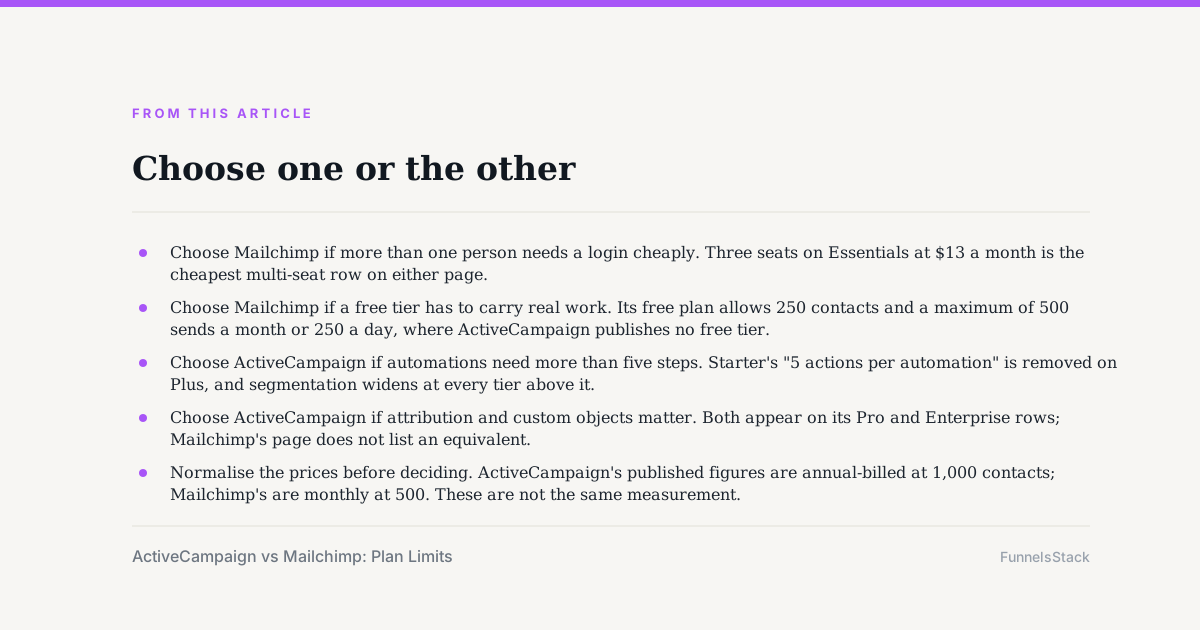
Choose one or the other
- Choose Mailchimp if more than one person needs a login cheaply. Three seats on Essentials at $13 a month is the cheapest multi-seat row on either page.
- Choose Mailchimp if a free tier has to carry real work. Its free plan allows 250 contacts and a maximum of 500 sends a month or 250 a day, where ActiveCampaign publishes no free tier.
- Choose ActiveCampaign if automations need more than five steps. Starter's "5 actions per automation" is removed on Plus, and segmentation widens at every tier above it.
- Choose ActiveCampaign if attribution and custom objects matter. Both appear on its Pro and Enterprise rows; Mailchimp's page does not list an equivalent.
- Normalise the prices before deciding. ActiveCampaign's published figures are annual-billed at 1,000 contacts; Mailchimp's are monthly at 500. These are not the same measurement.
- Size the contact row first on either platform, because the send allowance is a multiple of it and both pages bill or block when it fills.
Frequently asked questions
Which is cheaper, ActiveCampaign or Mailchimp?
The published entry prices are $15 a month billed annually at 1,000 contacts on ActiveCampaign and $13 a month on Mailchimp Essentials at 500 contacts, checked October 11, 2026. They are close, but not measured the same way.
Does ActiveCampaign publish a monthly price?
Not on the pricing page as rendered on October 11, 2026. The monthly field appeared empty beside the annual figure, so the monthly rate could not be read and has to be confirmed at checkout or by contacting sales.
How many emails can I send each month?
A multiple of your contact tier on both. ActiveCampaign lists 10x on Starter and Plus, 12x on Pro and 15x on Enterprise. Mailchimp lists 10X on Essentials, 12X on Standard and 15X on Premium.
Does Mailchimp have a free plan?
Yes. It allows 250 contacts, one seat and a "Max of 500/mo or 250/day" in sends, with no A/B testing, per the pricing page checked October 11, 2026. ActiveCampaign publishes a 14-day trial rather than a free tier.
How many users do I get on the cheapest plan?
One on ActiveCampaign Starter and Plus, rising to 3 on Pro and 5 on Enterprise. Three on Mailchimp Essentials, 5 on Standard and unlimited on Premium. Mailchimp is substantially cheaper per seat at entry.
What happens if I go over the limit?
Mailchimp states that "overages apply if contact or email send limit is exceeded", meaning a charge rather than a block. ActiveCampaign's pricing page publishes no overage behaviour that could be read on October 11, 2026.
Is ActiveCampaign Starter enough to run automations?
Only short ones. Starter lists "5 actions per automation", so a welcome sequence with several delays, tags and branches will not fit. Plus and above list unlimited automation actions.
Bottom line
The two platforms charge for the same thing in the same shape, so the headline prices are a poor way to choose between them. Normalise the billing period and the contact tier first, then the gap narrows considerably.
After that, the decision is structural. Mailchimp sells seats cheaply and gates testing. ActiveCampaign sells automation depth and gates seats. Pick the one whose gate sits furthest from your actual bottleneck.
Whichever you pick, count the real list before the first invoice rather than after, which is the first task in our fourteen-day free trial checklist.
Then re-read both pages at renewal. Contact sliders and send multiples are the two rows vendors adjust most often, and the reading order that catches those changes is in how to read a funnel builder pricing page.
One caveat on the figures above. ActiveCampaign's prices were taken from the rendered pricing page after the monthly values failed to load in a plain fetch, so treat the annual rate as the only published number.
Confirm the rest inside the account before the second invoice. The same caution applies to any slider-driven pricing page, which is why the free trial checklist schedules the list import on the first day rather than the last.
Sources
- ActiveCampaign pricing (annual-billed plan prices at 1,000 contacts, send multiples, users, automation actions, segmentation tiers, business goals, trial wording) (checked Oct 11, 2026)
- Mailchimp marketing pricing (plan prices, 500 and 10,000 contact bases, send multiples, seat counts, multivariate testing, overage wording, 15% offer) (checked Oct 11, 2026)