How Monthly Email Send Limits Are Counted
A contact allowance and a send allowance are two different meters, and only one of them tells you how often you can email. One platform publishes both numbers, two publish unlimited sends and cap something else. Read October 25, 2026.
This article is a documentation review: it is based on the vendors' own published pages, checked on the date shown. We may earn a commission from some links; it never affects what we recommend.
Two numbers decide how often you can email a list: how many people you may store, and how many messages you may send each month. Funnel platforms publish the first far more loudly than the second.
Of the three pricing pages read on October 25, 2026, only one printed both figures on every plan. The other two printed unlimited sends and metered a different row instead. Divide them and the plans look nothing alike.
ClickFunnels publishes both numbers, so the ratio is readable
The ClickFunnels comparison table carries two separate rows. Email Contacts reads 10K, 75K, 150K and 400K. Emails/Month reads 50K, 300K, 750K and 1.2M across the same four plans.
The tooltip on the second row is explicit: "Your monthly email sending limit - use it to nurture leads, make offers, and grow your business." So it is a hard monthly ceiling, not a fair-use note.
The plans are Launch at $97 per month, Scale at $197, Optimize at $297, and Dominate at $5,997 per year. Annual rates on the first three read $81, $164 and $248 per month.
Our arithmetic on those two rows gives the number that actually matters, which is sends per contact per month: 5.0 on Launch, 4.0 on Scale, 5.0 on Optimize and 3.0 on Dominate.
That is the ceiling on frequency. A full 10,000-contact list on Launch can receive five emails in a month and no more, which is roughly one a week with nothing left for a launch sequence.
The ratio gets worse as you climb, not better. Dominate carries 40 times the contacts of Launch but only 24 times the sends, so the biggest plan is the most frequency-constrained per person.
One more row belongs in this calculation. Dedicated IP (Email) is marked not included on Launch, Scale and Optimize, and ticked only on Dominate, so deliverability control arrives at the top of the ladder.
Kajabi prints unlimited sends and meters contacts hard
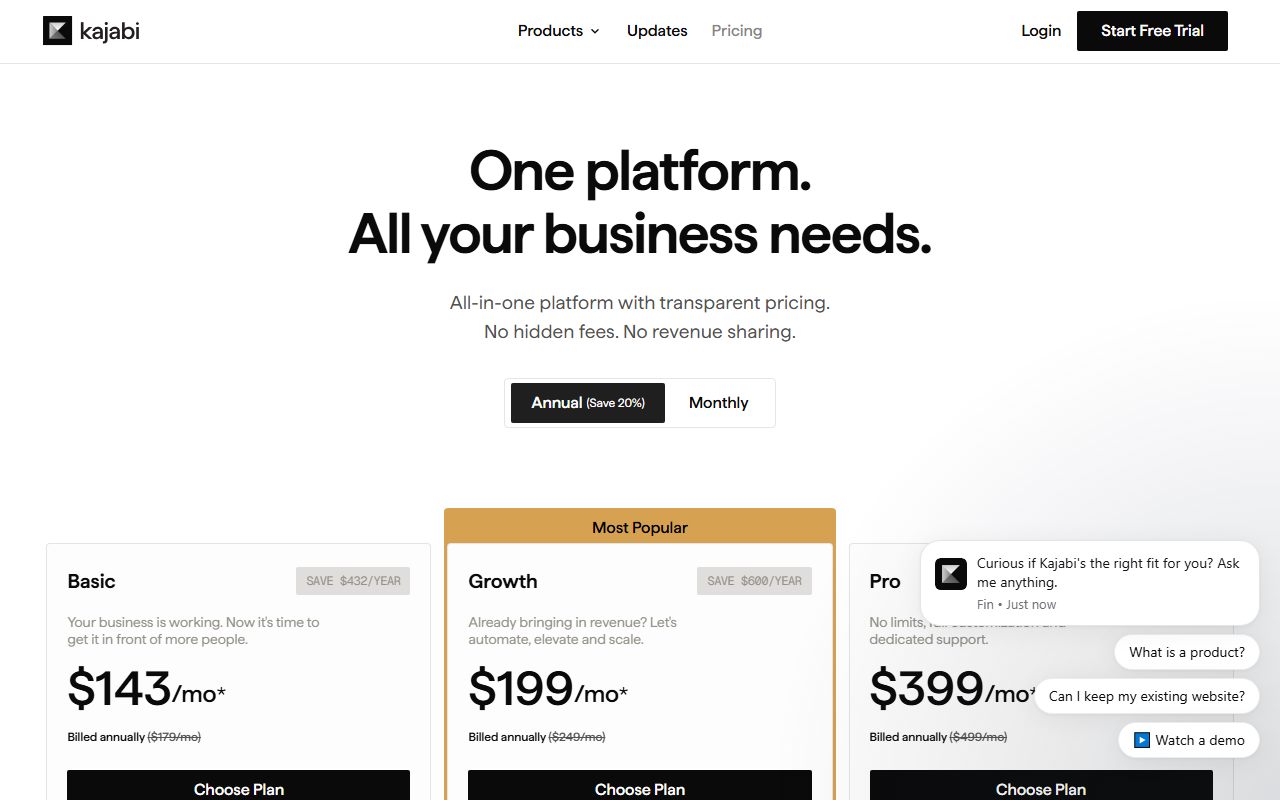
Kajabi inverts the design. Its comparison row Marketing emails reads Unlimited on all three plans, with the explanation "No send limits and no charge per email" sitting directly under the row name.
The plan cards repeat it, each listing a contact figure "included, unlimited email sends". Those contact figures are 2,500 on Basic, 25,000 on Growth and 100,000 on Pro.
Prices are $179, $249 and $499 per month. On annual billing the same cards read $143, $199 and $399 per month, billed annually at $1,716, $2,388 and $4,788.
So the meter is the list, not the frequency. A 2,500-contact Basic account can email daily if it wants, which our arithmetic puts at 75,000 sends in a 30-day month at no extra charge.
Compare that with the ClickFunnels figure above and the design choice is stark. 75,000 sends would be more than the Launch plan's entire monthly allowance of 50,000.
The trade is the contact ceiling. Basic stops at 2,500 people, where ClickFunnels Launch holds 10,000. Which ceiling binds first depends entirely on your list, as set out in what a funnel builder's contact limit counts.
Systeme.io prints unlimited sends and meters campaigns
Systeme.io also lists Emails sent as Unlimited on all four plans, and Email newsletters as Unlimited as well. The row it does meter is Email campaigns: 1 on Free, 10 on Startup, 100 on Webinar and Unlimited.
Those plans are published at $0, $17, $47 and $97 per month. Contacts run 2,000, 5,000, 10,000 and Unlimited. Tags run 1, 10, 100 and Unlimited, which is a quieter brake on segmentation.
The distinction worth understanding is campaign against newsletter. A newsletter is one broadcast; a campaign is a stored sequence. Free allows one stored sequence, so a welcome series and a sales series cannot coexist.
Automation rules follow the same shape at 1, 10, 100 and Unlimited, and workflows at 1, 5, 20 and Unlimited. Building the first of those sequences is covered in how to build a welcome email sequence in a funnel builder.
On this read the page described annual billing as "2 months free" but printed no annual dollar total, so we quote monthly prices only and suggest confirming the annual figure at checkout.
The rest of that ladder, including funnels, domains and courses, is set against its nearest rival in ClickFunnels vs Systeme.io plans.
Work out your own send number before you compare plans
The arithmetic is short and it changes which plan wins. Multiply your list size by the emails you plan to send each month, then check that total against the Emails/Month row rather than the contact row.
- A 5,000-person list on a twice-weekly newsletter is about 43,000 sends a month, which fits inside ClickFunnels Launch at 50,000 with nothing to spare.
- Add one four-email launch sequence to the same list and it is 63,000 sends, which does not fit. The contact row would have told you it did.
- On Kajabi the same 5,000-person list needs the Growth plan for contacts at $249 per month, but no send figure applies at all.
- On systeme.io the same list needs Startup at $17 for contacts, but the 10-campaign cap limits stored sequences rather than volume.
- Transactional mail counts too on most platforms. Receipts, course drips and reminders draw on the same monthly allowance unless the page says otherwise.
The vocabulary differs between vendors more than the pricing does, and that is the real trap. The terms to translate first are listed in how to read an email automation pricing page.
Dedicated sending tools draw the line in yet another place, metering subscribers and leaving sends open. Two of them are compared in Kit vs beehiiv for a paid newsletter, and two more in ActiveCampaign vs Mailchimp plan limits.
Frequently asked questions
How many emails can ClickFunnels send per month?
Per the comparison table read October 25, 2026: 50,000 on Launch, 300,000 on Scale, 750,000 on Optimize and 1.2 million on Dominate, against contact allowances of 10K, 75K, 150K and 400K.
Does Kajabi limit email sends?
Its comparison row reads Unlimited on all three plans, described as "No send limits and no charge per email". The meter is contacts instead: 2,500 on Basic, 25,000 on Growth, 100,000 on Pro.
What is an email campaign on Systeme.io?
A stored sequence, metered separately from broadcasts. The table allows 1 campaign on Free, 10 on Startup, 100 on Webinar and Unlimited on the top plan, while newsletters and sends are listed as Unlimited.
Which plan gives the most sends per contact?
Among the three published ClickFunnels monthly tiers, Launch and Optimize both work out at 5 sends per contact per month on our arithmetic. Scale gives 4 and Dominate gives 3.
Do receipts and course emails count against the limit?
Assume yes unless the page states otherwise. None of the three pricing pages read on October 25, 2026 carved transactional mail out of the monthly send row, so budget for it in the same total.
Bottom line
Do not compare contact allowances. Compare sends per contact per month, because that is the number that decides whether you can run a launch sequence without buying the next tier mid-campaign.
If you email often to a small list, the unlimited-send design on Kajabi or systeme.io costs less. If your list is large and you email rarely, the ClickFunnels contact headroom is the better buy.
Then confirm the figure at checkout. All three of these pages changed wording during October 2026, and a send row is the easiest one for a vendor to revise quietly.
Sources
- ClickFunnels plans and pricing (Email Contacts and Emails/Month rows) (checked Oct 25, 2026)
- Kajabi pricing (plan cards and "Compare every feature" table) (checked Oct 25, 2026)
- Systeme.io pricing ("Compare plans & features" table, email marketing rows) (checked Oct 25, 2026)