Rank Prompt Review: What Each Plan Actually Costs
Rank Prompt tracks six AI engines on every plan and meters the work in credits. The cards show the annual rate, not the monthly one, and a second meter bills the agent in dollars. Every figure read from the vendor’s own pages on October 26, 2026.
This article is a documentation review: it is based on the vendors' own published pages, checked on the date shown. We may earn a commission from some links; it never affects what we recommend.
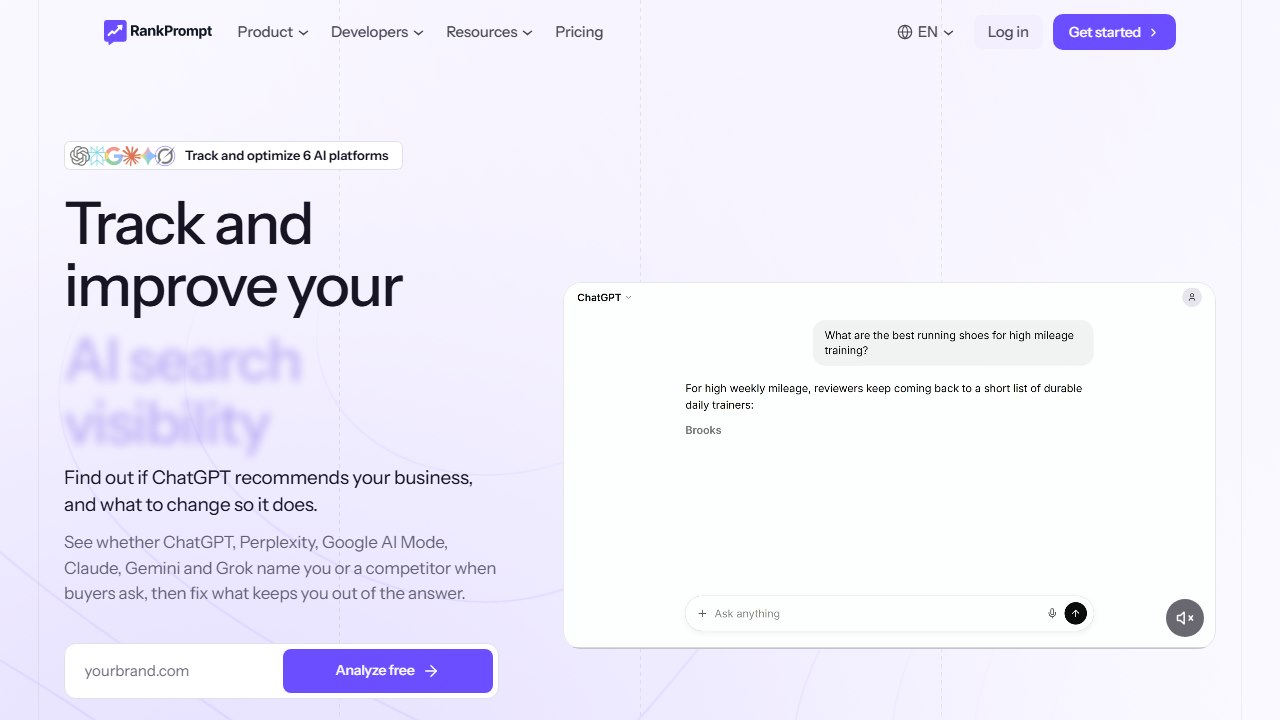
Rank Prompt checks whether ChatGPT, Perplexity, Google AI Mode, Claude, Gemini and Grok name your brand when buyers ask. Four paid plans run from $49 to $299 a month, metered in credits. Every figure here was read from the vendor’s pages on October 26, 2026.
The prices on the plan cards are not the monthly prices. They are the annual rate divided by twelve, and the page opens on that toggle. Check Rank Prompt’s current plans before budgeting against anything below.
The price on the card is the annual rate, not the monthly one
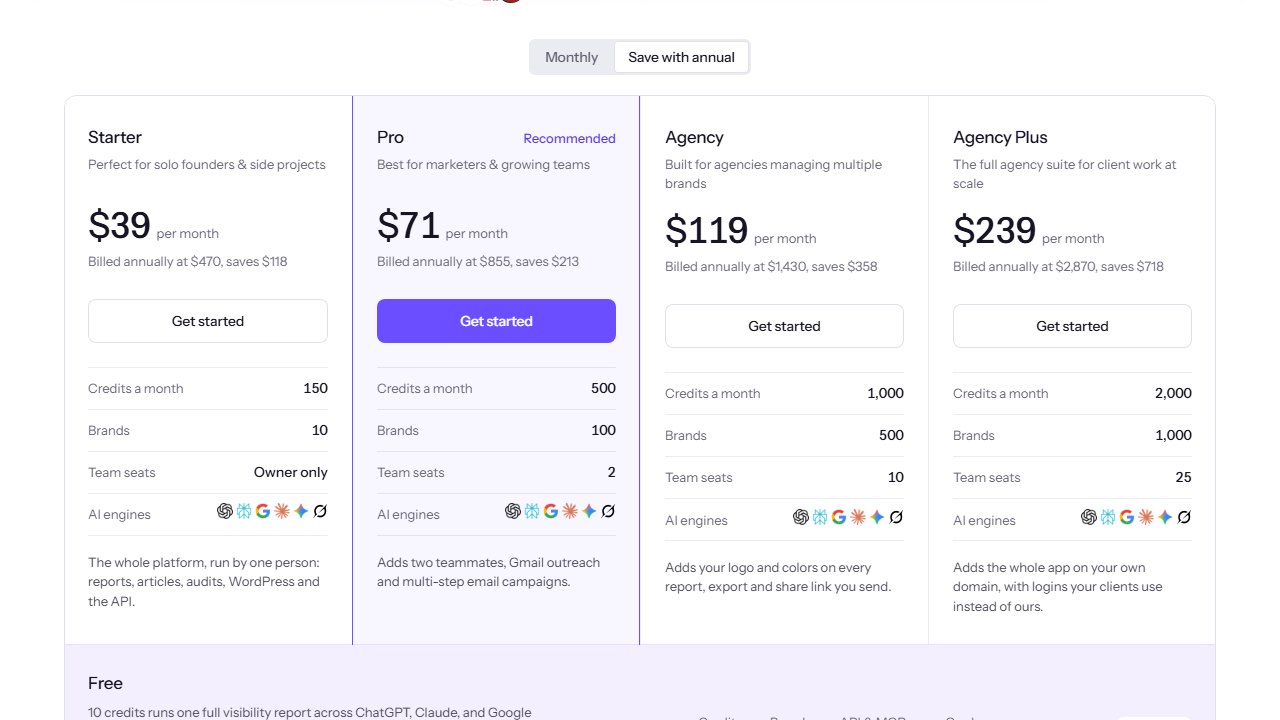
The four cards read $39, $71, $119 and $239 per month. Under each sits a billing line: $470 a year saving $118 on Starter, then $855 saving $213, $1,430 saving $358 and $2,870 saving $718.
Add the saving back to the annual total and divide by twelve. Our arithmetic on those published figures gives monthly rates of $49, $89, $149 and $299, which are the numbers the vendor prints elsewhere in plain text.
The pricing FAQ confirms two of them directly, describing Agency ($149/mo) and Agency Plus ($299/mo). The AI Visibility API page lists all four: Starter $49, Pro $89, Agency $149 and Agency Plus $299, each against a monthly request cap.
That makes the annual discount almost exactly 20% on every tier, by our arithmetic, rather than the varying savings the cards imply. Why the default toggle matters is covered in annual versus monthly billing.
| Plan | Card price (annual toggle) | Annual total | Monthly price | Credits a month | Brands | Team seats | AI agent budget | API requests a month |
|---|---|---|---|---|---|---|---|---|
| Free | — | — | $0 | 10 | 3 | Owner | — | Included |
| Starter | $39/mo | $470 (saves $118) | $49 | 150 | 10 | Owner only | $5 | 10,000 |
| Pro | $71/mo | $855 (saves $213) | $89 | 500 | 100 | 2 | $10 | 25,000 |
| Agency | $119/mo | $1,430 (saves $358) | $149 | 1,000 | 500 | 10 | $15 | 50,000 |
| Agency Plus | $239/mo | $2,870 (saves $718) | $299 | 2,000 | 1,000 | 25 | $25 | 100,000 |
Source: the Rank Prompt pricing page, its full comparison table and the AI Visibility API pricing block, all read October 26, 2026. Monthly prices are the vendor’s own figures from its FAQ and API page.
Credits are the meter, and the sixth engine costs double
Every plan carries a monthly credit allowance: 150, 500, 1,000 and 2,000, with 10 on Free. Credits reset on the billing date and, in the vendor’s words, “don’t roll over” to the next month.
The engine count is what catches people. One prompt analysed across up to three engines is 1 credit. The same prompt across four to six is 2. Tracking all six doubles the cost of identical coverage.
The page says ChatGPT, Claude and Google AI Mode run by default, so the cheap setting is the one you get unless you tick the rest. Adding Perplexity, Gemini and Grok is the moment the meter changes.
| What you run | Published credit cost |
|---|---|
| One prompt, up to 3 engines | 1 |
| One prompt, 4 to 6 engines | 2 |
| AI-generated article | 10 (9 each in one plan of 5 or more, 8 from 20) |
| Brand Audit | 10, plus 3 for its action plan, up to 10 cited pages |
| Extra cited pages in an audit | 1 per 3 pages |
| Page speed (Lighthouse) or competitor audit | 1 |
| Prospect search | 5 |
| Technical SEO check | Free |
Run the arithmetic the vendor’s own calculator runs. Twenty-five prompts for one brand, all six engines, checked weekly, is 25 × 2 × 4, or 200 credits a month. Starter’s 150 does not cover it.
Drop to three engines at the same cadence and it costs 100 credits, inside Starter. Drop to monthly checks on six engines and it is 50. The schedule, not the plan name, decides the tier you need.
Top-ups are sold at $18 for 50 credits, $35 for 100 and $65 for 200, and the page says they never expire. That is $0.33 to $0.36 a credit, against roughly $0.18 on Pro and $0.15 on Agency by our arithmetic.
So a Starter account that tops up every month is paying Starter’s own rate again rather than Pro’s. Credit meters reward the bigger plan in the same way audio ones do, as set out in what ElevenLabs credits cost.
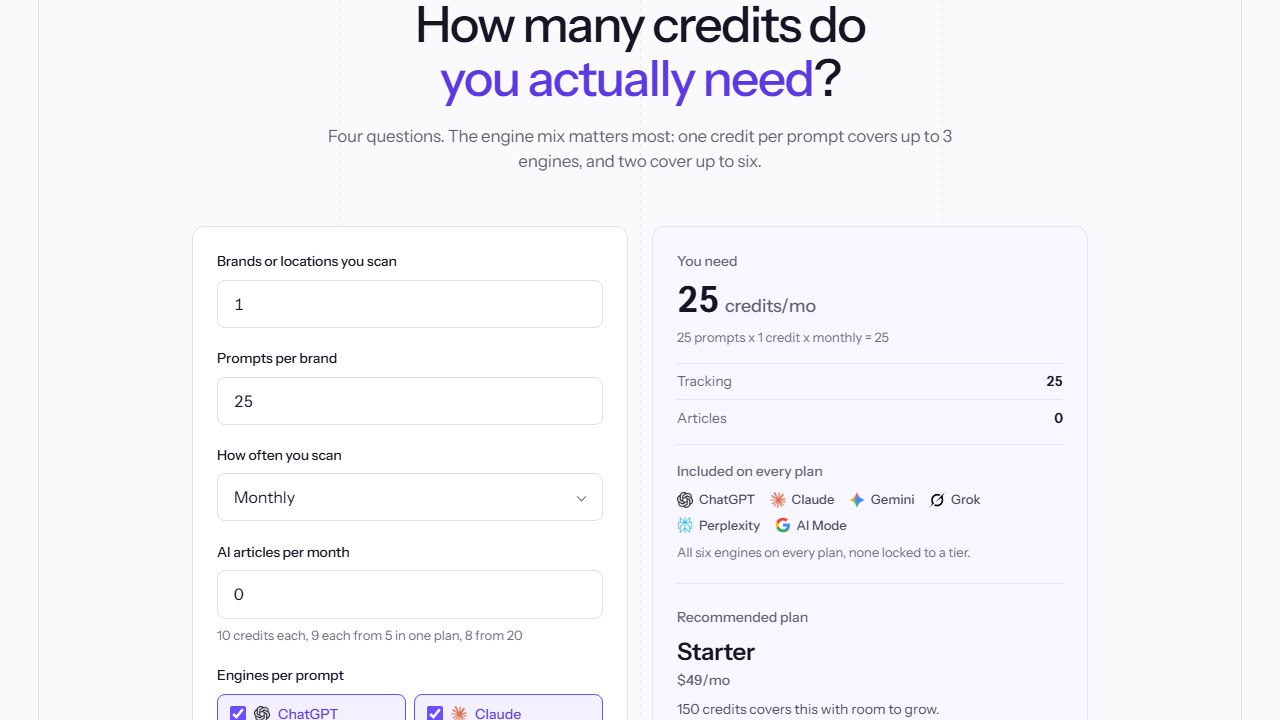
Price your own prompt count on Rank Prompt’s plan page before picking a tier, because the credit figure moves with the engine mix and the scan frequency, not with the brand count.
Brands, seats and white label are what the tiers actually gate
All six engines are on every plan, including Free. The comparison table confirms it with one row carrying the same six icons across all four columns. No engine is locked behind a tier.
Brands run 10, 100, 500 and 1,000 across the paid plans, with 3 on Free. Team seats are the harder gate: Starter is listed as Owner only, then 2 on Pro, 10 on Agency and 25 on Agency Plus.
So a two-person team cannot use Starter at all, whatever its credit allowance permits. That shape of limit is the same one described in how funnel tool sub-accounts are priced.
White label starts at Agency: your logo and colors on every report, export and share link, a client portal per brand, your own sending domain and priority support. Agency Plus adds the whole app on your own domain with client logins.
The Google-side limits scale too. Rank-tracked Google keywords per brand run 25, 100, 250 and 500, and on-demand rank checks per brand per day run 50, 200, 500 and 1,000 across the four plans.
Agent Mode is billed in dollars, on a second meter
The AI agent does not draw on credits. The FAQ states its usage is “tracked in US dollars based on underlying model API cost”, with a monthly budget of $5 on Starter, $10 on Pro, $15 on Agency and $25 on Agency Plus.
That budget resets each billing cycle. It can be topped up mid-cycle with report credits, and the vendor states the added budget resets at the end of the cycle. An in-app meter shows dollars used and remaining.
Two meters on one bill is unusual, and $5 of model spend is a thin allowance for something the homepage calls an “always-on AI SEO copilot”. The page publishes no conversion rate from credits to agent dollars.
The API and MCP server are open on every plan, free included
Monthly request caps are 10,000 on Starter, 25,000 on Pro, 50,000 on Agency and 100,000 on Agency Plus, with a burst limit of 120 requests per minute per key. Calls that consume credits still draw on the plan allowance.
There are also two standalone API subscriptions for accounts with no dashboard plan: API Starter at $99 a month with 50,000 request units and 500 prompts, and API Pro at $299 with 200,000 units and 2,000 prompts.
The MCP server connects Claude Code, Cursor and Claude Desktop over OAuth rather than a pasted key. The free plan includes API and MCP access alongside its 10 credits and needs no card.
One caveat the API page prints itself: brand audits, AI content, technical SEO audits and outreach are each marked Coming soon as endpoints, even though the dashboard ships them. The API is narrower than the product.
What the pricing page does not settle
The monthly-billed figures are the first gap. They appear in the FAQ and on the API page but not on the cards, so a buyer who reads only the cards budgets $39 and is charged $49.
The refund terms are the second. The FAQ says to “contact support within 24 hours of a charge” for a full-refund review; after that it does not refund, annual plans are not prorated on cancellation, and credit top-ups are non-refundable.
The third is the social proof. The 5.0/5 G2 badge and the “10,000+ customers” line are vendor claims. G2’s own product page returned HTTP 403 on October 26, 2026, so neither figure is verified here, and nor are the enterprise logos.
Nothing in this review comes from inside a paid account. No visibility score, refresh time or output quality is tested, and the “couple of minutes” quoted for the first report is the vendor’s wording, not a measurement.
Tax treatment is not addressed on the page either. Reading for what a plan page leaves out is the habit described in how to read a funnel builder pricing page.
Who each plan fits
- Free at $0 fits one look. 10 credits, 3 brands, no card and no time limit, with API and MCP access included. The page says 10 credits is exactly one full report across ChatGPT, Claude and Google AI Mode.
- Starter at $49 fits a solo founder tracking one brand monthly on three engines. It is owner-only, so the moment a second person needs access the plan is wrong regardless of credits.
- Pro at $89 is the real entry tier for a team: 2 seats, 500 credits, 100 brands, Gmail outreach and multi-step email campaigns. It is also where weekly six-engine tracking stops breaking the allowance.
- Agency at $149 is the white-label step: your branding on reports, exports and share links, a client portal per brand, your own sending domain, 10 seats and 1,000 credits.
- Agency Plus at $299 buys the operations layer: a cross-brand dashboard, client logins on your own domain, article approvals, prospecting and a lead widget, with 25 seats and 2,000 credits.
- Skip it if the job is Google rankings alone. The keyword limits of 25 to 500 per brand are modest next to a dedicated rank tracker, and the credits are priced for AI answers instead.
Frequently asked questions
How much does Rank Prompt cost per month?
The cards show $39, $71, $119 and $239, but those are annual rates. Billed monthly the plans are $49, $89, $149 and $299, figures the pricing FAQ and the API page both print. Checked October 26, 2026.
Is there a free plan?
Yes. Every account starts free with 10 credits, 3 brands, no credit card and no time limit, and the API and MCP server are included. The page says 10 credits runs one full report across ChatGPT, Claude and Google AI Mode.
How do Rank Prompt credits work?
One prompt across up to three engines is 1 credit; across four to six it is 2. An AI article is 10, a Brand Audit 10 plus 3 for its action plan, a page speed or competitor audit 1, and a prospect search 5. Technical SEO checks are free.
Which AI engines does Rank Prompt track?
Six: ChatGPT, Google AI Mode, Perplexity, Claude, Gemini and Grok. All six are on every plan including Free, with ChatGPT, Claude and Google AI Mode running by default. Adding the other three doubles the credit cost per prompt.
Do unused credits roll over?
No. The FAQ states credits reset at the start of each billing cycle and do not roll over. One-time top-ups of 50, 100 or 200 credits, at $18, $35 and $65, never expire and stack on top of the monthly allowance.
Does Rank Prompt offer refunds?
Narrowly. The page says to contact support within 24 hours of a charge for a full-refund review; after that it does not refund, annual plans are not prorated on cancellation, and top-ups are non-refundable. Run the free report first.
How many people can use one account?
Starter is owner-only. Pro includes 2 seats, Agency 10 and Agency Plus 25, with 100 client logins listed on the Agency Plus row. A second user therefore means Pro at $89 a month, not Starter at $49.
Is the 5.0/5 G2 rating verified?
Not in this review. The badge appears on Rank Prompt’s own pages beside a “10,000+ customers” line. G2’s product page returned HTTP 403 on October 26, 2026, so both stand here as the vendor’s claims.
Bottom line
The product is coherent: six engines on every plan, one credit meter, and an API plus MCP server open even on the free tier. For an agency, Agency at $149 buys the white-label layer most clients expect to see.
The pricing presentation is the weak part. Cards default to the annual rate, the monthly figures sit in the FAQ, and a second meter in dollars runs the agent. Three numbers decide your bill: engines per prompt, scan frequency and seats.
Settle the refund window before paying. Twenty-four hours is short, annual plans are not prorated, and top-ups are non-refundable, which leaves the free report as the only risk-free way to judge the output.
Run the free report and price up from the published rates, then read whichever limit your own numbers break first, using the method in how to read a funnel builder pricing page.
Related reading: the Manychat review, what “unlimited” means on a plan page, the funnel builder free trial checklist and how to read a membership site pricing page.
Sources
- Rank Prompt pricing (plan cards, annual totals, credit calculator, full comparison table and FAQ) (checked Oct 26, 2026)
- Rank Prompt homepage (six engines, “10,000+ customers” and 5.0/5 G2 badges, 23 AI crawlers) (checked Oct 26, 2026)
- Rank Prompt AI Visibility API (monthly plan prices, request caps, 120 req/min, standalone API plans, “Coming soon” endpoints) (checked Oct 26, 2026)
- Rank Prompt changelog (v9, October 2026: Autopilot, Sources, Explorer) (checked Oct 26, 2026)