Put a Voice on Every Step of Your Funnel With ElevenLabs
A funnel has five places where sound changes behaviour: the ad, the landing page, the order page, the welcome sequence and the follow-up call. This is the working order for producing each one in ElevenLabs, with the credit cost of every step written next to it so nothing surprises you on the invoice.
This article is a documentation review: it is based on the vendors' own published pages, checked on the date shown. We may earn a commission from some links; it never affects what we recommend.
Most funnels are silent until the sales call. The ad plays muted in a feed, the landing page is a wall of text, the order page is a form, and the welcome emails are more text. Adding a voice at the right points is cheap now. ElevenLabs sells speech by the character, and a two-minute landing page script costs about 1,800 credits, which is six cents of a $6 Starter plan. What follows is the order we would produce those assets in, step by step, with the credit arithmetic for each one, based on the ElevenLabs pricing and product pages read on October 13, 2026.
This is a working playbook, not a review. If you want the plan ladder and the fine print on billing first, read what a funnel's audio actually costs in ElevenLabs credits and come back. If you want to follow along, open ElevenLabs in a second tab; the free plan is enough for the first three steps.
Before you start: one voice, one script format, one credit budget
Three decisions up front save hours later. Make them before generating a single clip.
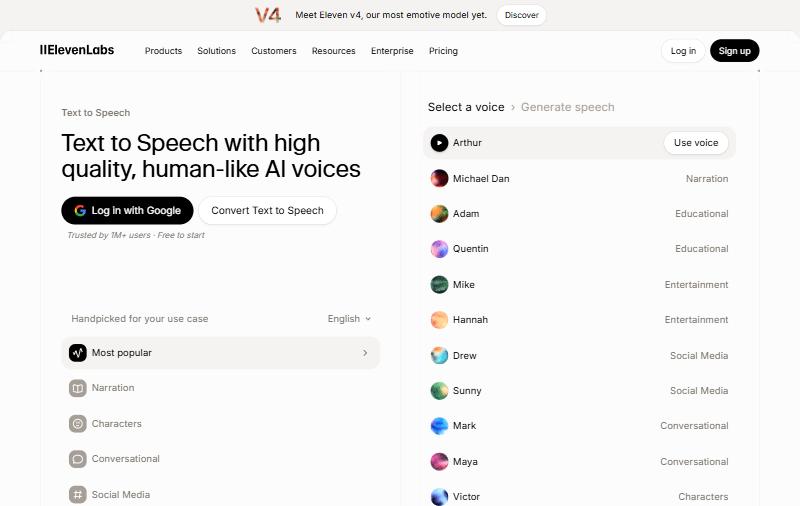
- Pick one voice and keep it. A funnel that sounds like four different people reads as four different companies. Browse the voice library on the free plan, shortlist two, and generate the same 30-second script with both. Keep the one you would be comfortable hearing on a sales call.
- Write scripts as plain text with inline tags. The current default model, Eleven v4, is directed with tags written straight into the script, such as [pause] or [excited], rather than a separate markup language. Write every script in one document so tone edits are a find-and-replace, not a re-record.
- Set a credit ceiling per asset. One character of text equals one credit on text to speech. Count the characters in each script before you generate, and you know the cost before you click.
The credit figures below use that one-character-equals-one-credit rate from the pricing page, with the page's own conversion of roughly 1,000 characters to one minute of speech. Your scripts will differ; the method does not.
Step 1: the ad (where a voice buys you the first three seconds)
Start at the top because it is the asset you will remake most often. A paid social ad usually needs one 15-second and one 30-second cut, each in two or three script variants, and the voice has to carry the hook because the caption is often read with sound off.
A 30-second script runs about 450 to 500 characters. Five variants is 2,500 credits. Even the free plan's 10,000 monthly credits covers that, but the free plan carries no commercial licence, and a published ad needs one. That licence starts on Starter at $6 a month, so Starter is the real entry point for ad work.
Production order that works: write the hook lines first, generate only the hook as separate five-second clips, play them back to back, pick the two that land, then generate the full scripts. You burn credits on 50-character hooks instead of 500-character scripts while you are still deciding.
Export at the highest sample rate your plan allows and let the ad platform compress it. Re-uploading a clip already compressed by two tools is where that thin, metallic sound comes from.
Step 2: the landing page (a 90-second explainer, not a 10-minute VSL)
The temptation is a long video sales letter. Resist it for the first pass. A 90-second spoken summary above the fold, with the full text underneath, serves cold traffic better than a ten-minute video that nobody finishes on a phone.
Ninety seconds is roughly 1,400 characters, so one landing page voice costs about 1,400 credits. Generate it twice, once at the default settings and once with the Stability slider higher, and A/B the two. Eleven v4 keeps two sliders, Stability and Similarity; the Style and Speed controls from earlier models are gone, so stability is the one lever you have.
If you do want the long VSL later, write it in chapters of under 10,000 characters each, which is the per-generation limit on Eleven v4, and stitch them in your editor. That is about ten minutes of audio per chapter.
Put the audio player next to the headline, not in the hero image. The page still has to convert with the player closed, which is also what the funnel builder free trial checklist tells you to test first: the page without any media loaded.
Step 3: the order page and the bump
An order page is a bad place for a long voice. It is a good place for one short reassurance clip, 15 to 20 seconds, that explains the guarantee and what happens after checkout. That is about 300 credits. The same clip, re-recorded at the same length for the order bump, explains what the bump adds in one sentence.
Keep both clips off autoplay. A voice that starts talking on a checkout page while someone is typing a card number is a reason to leave, not a reason to stay. If your order bump and upsell logic is still being decided, the mechanics are laid out in order bump versus upsell versus downsell.
Step 4: the welcome sequence as audio
This is the step most funnels skip, and it is the cheapest one. A five-email welcome sequence of about 300 words per email is roughly 1,800 characters per email, or 9,000 credits for the full set. Record each email as a 'listen instead' link at the top of the message.
The reason it works is not novelty. A new subscriber on a phone will play a two-minute clip on a commute far more readily than they will read eight paragraphs. The text stays in the email for everyone else.
Record the sequence after you have finalised the copy. Every edit to an email is a re-generation, and ElevenLabs charges credits for every generation, including the ones you throw away. The sequence structure itself, and the timing between messages, is covered in how to build a welcome email sequence.
Credit check so far: five ad variants (2,500), one landing page clip generated twice (2,800), two checkout clips (600) and five emails (9,000) is about 14,900 credits. That is half of a Starter month, or one eighth of a Creator month at 121,000 credits.
Step 5: the follow-up call, if you want one
The last step is the only one that changes the bill's shape. ElevenLabs sells voice agents under a separate product line, ElevenAgents, and those are priced per call minute rather than per credit. An agent that calls back new leads to qualify them, or answers the inbound line after hours, is built in that product's workflow builder and connected to a phone number.
Two cautions before you build one. First, the voice model behind agents is the low-latency variant, Eleven v4 Turbo, and the published latency figures exclude network and application time, so test an end-to-end call before promising anyone an instant answer. Second, the language model that generates the agent's replies is metered separately from ElevenLabs' own minutes, so an agent has at least two bills, and three if telephony is billed through them as well.
Our suggestion is to run steps one to four for a full month on Starter or Creator, read the invoice, and only then decide whether an agent belongs in the funnel. The ElevenLabs agents page lists the current per-minute rates.
Localising the whole funnel once it works
Once the English version converts, the same scripts can be re-generated in another language with the same voice. Eleven v4 lists 90+ languages on its product page, and one behaviour worth knowing: when the target language differs from the voice's original language, v4 speaks with a native accent rather than carrying the original one across. For a sales funnel that is usually what you want. For a founder-voice brand it may not be.
Translation is not included in a text-to-speech generation; you still need the translated script. Dubbing Studio, available from Starter up, handles translation and voice together for video, and draws from the same credit pool at a higher rate per minute than plain speech. Budget it separately.
Mistakes we see in funnels that added voice
- Generating before the copy is final. Every regeneration costs the full character count again. Lock the script, then record.
- Autoplay on the checkout page. It reads as an ambush. Click-to-play only, below the headline.
- Using the free plan for a live ad. Free has no commercial licence. The $6 Starter plan does.
- Spending all the credits on one long VSL. A ten-minute video is about 10,000 credits and gets watched to the end by very few. Five short clips in five places move more people.
- Forgetting the second and third meters on agents. Credits, language-model usage and call minutes are three different lines. Read the pricing FAQ before you wire a phone number.
What to do this week
- Open ElevenLabs on the free plan, audition two voices with the same 30-second script, pick one.
- Write the ad hooks and the 90-second landing page script in one document, count the characters.
- Move to Starter when you are ready to publish the ad, since that is where the commercial licence begins.
- Record the welcome sequence last, after the copy is signed off.
- Read the first invoice before deciding on a voice agent.
Prices, plan names and credit conversions above come from elevenlabs.io and its pricing page as read on October 13 and 15, 2026. They change; the live pricing page is the source of truth. FunnelsStack may earn a commission if you subscribe through links on this page, at no extra cost to you.
Sources
- ElevenLabs pricing (plan ladder, credit conversion, commercial licence from Starter) (checked Oct 13, 2026)
- ElevenLabs homepage (product lines, languages, voice library) (checked Oct 15, 2026)
- Eleven v4 product page (10,000-character limit, tags, 90+ languages, Turbo latency footnote) (checked Oct 13, 2026)
- ElevenLabs agents page (per-minute billing, workflow builder, telephony) (checked Oct 15, 2026)