Webinar Tools for a Funnel: What Plans Cap
Webinar plans cap three things at once: how many people can be in the room, how long the session may run, and what happens to the recording. We read four vendors' pricing pages and one help article on October 20, 2026 and lined the caps up side by side.
This article is a documentation review: it is based on the vendors' own published pages, checked on the date shown. We may earn a commission from some links; it never affects what we recommend.

A webinar step is the one funnel element where the plan can stop the event mid-sentence. Three caps do it: the attendee room, the maximum session length, and whether the recording survives afterwards.
Vendors meter all three differently, and two of them tie the clock to the price, so the cheapest plan also has the shortest webinar.
Below are the published caps for WebinarJam, Demio, Livestorm and systeme.io, read from their own pricing pages and help centre on October 20, 2026, plus the cost per attendee each model implies.
WebinarJam raises the room and the clock on the same ladder
WebinarJam is the clearest and the strictest. Each plan card names an attendee cap and a duration cap together, and the duration rises only when you pay more.
- Starter: $49/mo billed monthly or $39/mo annual, "100 Attendees/webinar", "1 hour max duration", "Includes 1 host".
- Basic: $99/mo or $79/mo annual, "500 Attendees/webinar", "2 hours max duration", "Includes 2 hosts".
- Professional: $299/mo or $229/mo annual, "2000 Attendees/webinar", "3 hours max duration", "Includes 4 hosts".
- Enterprise: $499/mo or $379/mo annual, "5000 Attendees/webinar", "4 hours max duration", "Includes 6 hosts".
- A trial is offered at "$1 /trial" for 14 days with a 500-attendee room.
The vendor's FAQ confirms both ladders in prose: "your webinars can host a maximum of 100, 500, 2000, or 5000 attendees per webinar" and "your webinars can be either 1, 2, 3 or 4 hours in length maximum".
The workaround it suggests for a longer event is worth quoting, because it affects your funnel sequencing: set up "a second session that is scheduled to begin 30 minutes after the first webinar", which lets the replay process.
Related advice on the same page: schedule webinars "at least 15-30 minutes apart" so encoding finishes "and the replay recording is fully functional". Build that gap into the automation that sends the replay link.
Evergreen is a separate product. The FAQ states that for automated webinars running on a fixed schedule you "use our companion product, EverWebinar", and convert a WebinarJam recording into it.
Demio meters the room and the clock separately, by host
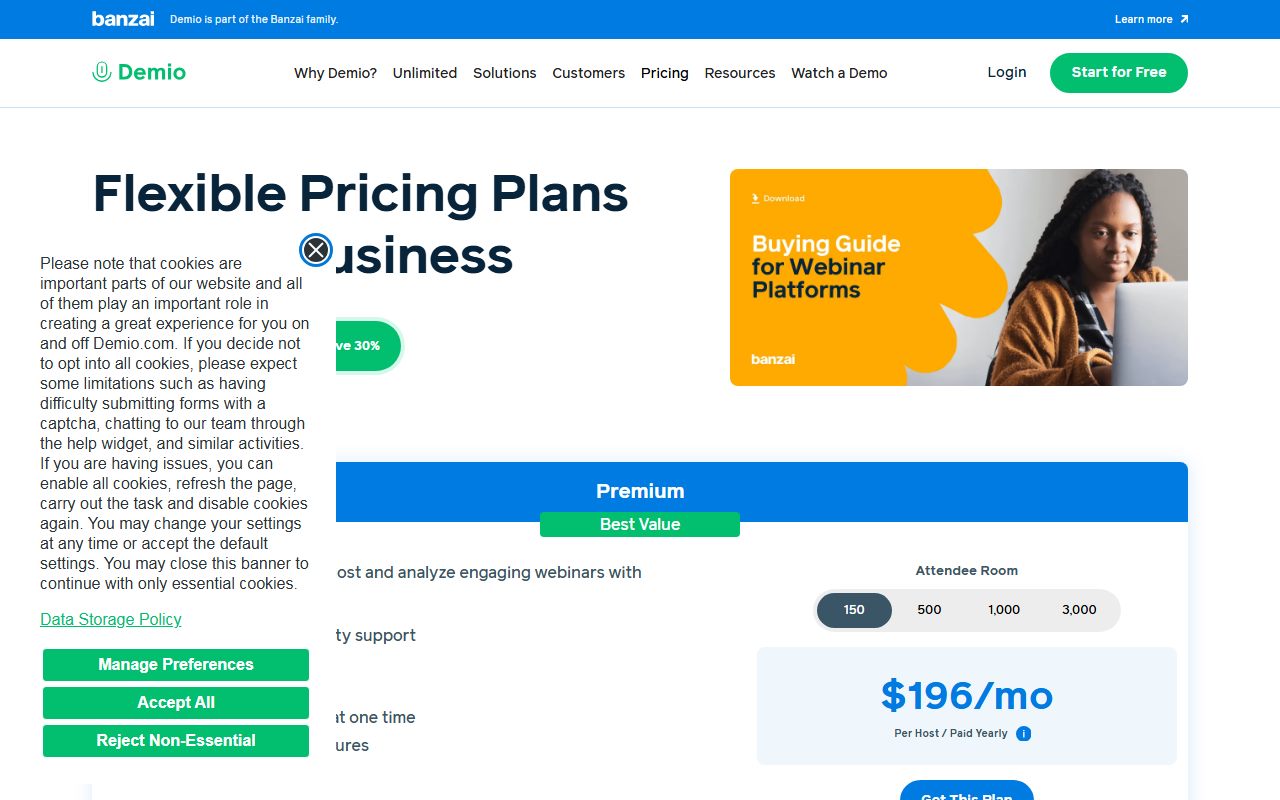
Demio prices per host and lets you pick a room size inside the plan. Starter is a single host with a 50-attendee room at $45/mo paid yearly or $63/mo paid monthly.
Growth and Premium both offer attendee rooms of 150, 500, 1,000 and 3,000. Growth is $80/mo per host paid yearly or $117/mo monthly. Premium is $196/mo per host paid yearly.
The session clock is a feature row, not a plan name. The comparison lists a "3-Hour Session Limit", an "8-Hour Session Limit" and a "10-Hour Session Limit" as the three steps, so Demio's entry tier already beats WebinarJam's top one on time.
There is a free tier, and the page states its limits plainly: it "has all the features included in our Growth plan, but is limited to 20 attendees and a 1-hour session limit". That is enough to rehearse, not to run a launch.
Hosts are the unit that bites. The page notes you "need to purchase multiple hosts if you plan to run more than one event simultaneously", that Starter is capped at one, and that Premium has "no limit to the number of hosts per account".
Livestorm charges per attendee, so the room is whatever you buy
Livestorm abandons the seat model entirely. Its pricing page headline reads "Only pay for actual attendees", and you buy a yearly pack of attendee credits instead of a room size.
The unit is defined precisely: "1 attendee credit is used for each unique participant, per session, over a 12-month period. Team members are not counted." A replay view counts, and the same person in two sessions spends two credits.
At the 400-credit selection we read, the Pro plan showed "$3.00 / attendee". Pro highlights include "Up to 4 hours/session" and "Unlimited events and recording". Enterprise is Custom and raises the clock to "Up to 12 hours/session".
The FAQ closes the double-count question: if someone "attend[s] live and later watch[es] the replay of the same session, they are only counted once for that session". Two different sessions still cost two credits.
systeme.io includes evergreen webinars, and counts them
If the webinar is only one step inside a funnel you already pay for, the builder may already include it. systeme.io's comparison table has an "Evergreen webinars" row reading 0 on Free, 0 on Startup, 10 on Webinar and Unlimited on Unlimited.
Its FAQ prices the tier that unlocks them: "Webinar ($47/month): 10,000 contacts, 50 sales funnels, 20 courses, plus evergreen webinars". The Unlimited plan is $97 a month.
Note what is not published there. The table gives a count of evergreen webinars, not an attendee cap or a duration cap, and we could not find either figure on the pricing page we read on October 20, 2026.
These are automated replays rather than live rooms, which makes them a different product from WebinarJam or Demio. The plan ladder itself is compared in ClickFunnels vs systeme.io plans.
The recording is the row nobody reads
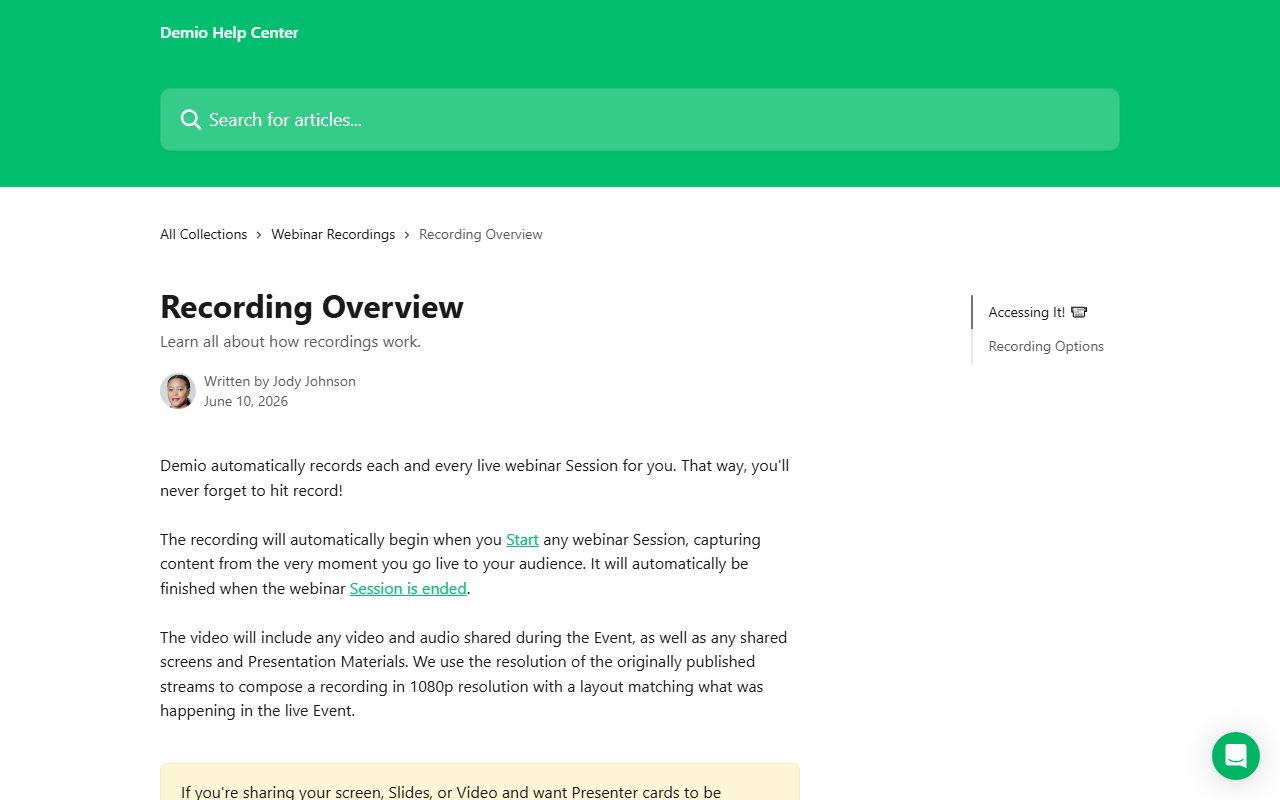
Demio is the most explicit of the four. Its help centre states: "All Recordings will be stored on your account for as long as your account is active. There's no limit to the number of Recordings you can store in your account."
Livestorm lists "Unlimited events and recording" as a Pro plan highlight. WebinarJam ties the recording to processing time rather than storage, which is why it asks for a gap between sessions.
Storage policy is what decides whether a recorded webinar can become an evergreen asset later. Check it before you promise a replay in an automated sequence like the one in how to build a welcome email sequence in a funnel builder.
Cost per attendee, run three ways
The arithmetic below is ours, from the published prices only. For a single 500-person webinar: WebinarJam Basic at $79 a month annual is $0.16 per attendee. Demio Growth with a 500 room at $80 a month per host is $0.16.
Livestorm Pro at $3.00 per attendee is $1,500 for the same 500 people. That is roughly 19 times the monthly price of either seat-based plan, which is the point of the model: you pay nothing for an empty room.
Flip the assumption and the ranking flips. One webinar a year with 40 attendees costs $120 on Livestorm's rate, against $948 for a year of WebinarJam Basic at the annual rate. Seat pricing only pays off at volume.
That is the same shape as every other recurring commitment in a funnel, and the discount maths is laid out in annual vs monthly billing for funnel builders.
What to check in the trial
- Run a session past the plan's clock on purpose and watch what happens at the cap, not what the marketing page says happens.
- Confirm the attendee number counts live viewers, replay viewers or both. Livestorm counts replays; the others do not say so on the pricing page.
- Check whether hosts are seats you must buy. Demio charges per host and caps Starter at one.
- Download the recording, not just view it, and check the format before you build a replay step.
- Count what the webinar step adds to your contact total, since every registrant becomes a contact.
That last item is the one that quietly raises the bill elsewhere, and it is counted differently by every vendor, as set out in what funnel builder contact limits actually count. The rest belongs on the funnel builder free trial checklist.
If the plan is to narrate the replay rather than re-record it, the audio cost is a separate meter again, priced in ElevenLabs credits and what funnel audio costs.
Frequently asked questions
What is the cheapest webinar plan that allows a two-hour session?
Of the four we read, Demio Starter at $45 a month paid yearly, because the comparison lists a 3-Hour Session Limit as its lowest step. WebinarJam needs Basic at $79 a month annual for two hours.
How many attendees does WebinarJam allow?
Its FAQ states a maximum of 100, 500, 2000 or 5000 attendees per webinar depending on subscription level, matching the Starter, Basic, Professional and Enterprise cards as read on October 20, 2026.
Does a replay viewer cost money on Livestorm?
Yes. The page states a credit is used for each unique participant per session whether they join live, watch the replay or watch on demand. Someone who does both for the same session is counted once.
Are webinar recordings kept forever?
Demio's help centre says recordings are stored "for as long as your account is active" with no limit on how many. Livestorm lists unlimited recording on Pro. We found no retention figure published by WebinarJam.
Can I run webinars inside a funnel builder instead?
systeme.io includes evergreen webinars, 10 on its $47 Webinar plan and unlimited on the $97 plan. Those are scheduled replays, not live rooms, and the pricing page publishes no attendee or duration cap for them.
Bottom line
Pick by the cap that will stop your event. If the room is big and the talk is short, WebinarJam's ladder is the cheapest per head. If the talk runs long, Demio starts at a 3-hour limit where WebinarJam's entry plan stops at one.
If webinars are occasional, Livestorm's $3.00 per attendee avoids paying for an empty room all year. And if the webinar is an automated replay inside a funnel you already own, systeme.io's Webinar plan at $47 a month may already cover it.
Sources
- WebinarJam pricing (plan cards and FAQ) (checked Oct 20, 2026)
- Demio pricing (plan cards and feature comparison) (checked Oct 20, 2026)
- Demio help centre: Recording Overview (checked Oct 20, 2026)
- Livestorm pricing (attendee credits and plan highlights) (checked Oct 20, 2026)
- systeme.io pricing (evergreen webinars row and FAQ) (checked Oct 20, 2026)