What a CRM Inside a Funnel Builder Includes
Funnel builders now list CRM as a headline feature. What that means in practice is a pipeline board and a contact record, metered by contacts rather than by seats, and the difference from a real sales CRM shows up in the rows below.
This article is a documentation review: it is based on the vendors' own published pages, checked on the date shown. We may earn a commission from some links; it never affects what we recommend.

Every funnel builder sells a CRM now. ClickFunnels lists "CRM Pipelines", HighLevel leads with "CRM & Pipelines", Systeme.io heads a whole section "Contacts & CRM".
What they mean is narrower than what Pipedrive or HubSpot mean, and the billing unit is the real tell: funnel builders charge for contacts, sales CRMs charge for seats.
That single difference decides which one is cheaper for you, and it has nothing to do with features. Every figure below comes from the vendors' own pricing pages, read on October 21, 2026.
In a funnel builder, CRM means a pipeline and a contact record
Systeme.io is the most explicit about the shape of it. Its comparison table lists "CRM Pipelines" as 1, 5, 20 and 100 across the Free, Startup, Webinar and Unlimited plans, priced at $0, $17, $47 and $97.
The same table gives contacts as 2,000, 5,000, 10,000 and Unlimited, and tags as 1, 10 and upward. So the CRM is a counted object inside the plan, like a funnel or a domain, rather than a separate product.
ClickFunnels meters it the same way. Its comparison table shows "CRM Pipelines" as 1 on Launch and a check mark on Scale, Optimize and Dominate. The adjacent "Calendars" row reads dash, 5, 10 and 20.
Two rows on that page are worth noting beside it. "Opportunities" carries a check on all four plans, while "Automations" shows a dash on Launch. A pipeline without automation is a board you move cards on by hand.
ClickFunnels plan prices are "$97", "$197" and "$297" monthly, or "$81/mo", "$164/mo" and "$248/mo" billed annually, with Dominate listed at "$5,997/yr".
HighLevel gives unlimited contacts and users, then meters the phone
HighLevel inverts the usual model. Its pricing page headline reads "Unlimited contacts, unlimited Users. Scale your business without a tax on growth." Starter is "$97 /Month" or "$970 /Year" with "3 Sub-Accounts".
The core feature list includes "CRM & Pipelines", "Custom Dashboards & Reporting", "Email + SMS Marketing*" and "Inbound & outbound calling*". The asterisk is the whole story: "*Usage based charges apply."
Its FAQ spells out what that covers: "your subscription covers the platform features, but there are usage-based costs for telecommunications and AI services... This includes charges for phone numbers, SMS (text messaging), emails sent".
So on HighLevel the CRM seat count is free and the conversations are metered. Its help centre publishes those per-segment rates separately from the pricing page. Chat-led follow-up is billed on the same logic, as in our ManyChat review.
The Unlimited plan at "$297 /Month" adds "Unlimited Sub-Accounts" and "Rebill Phone & Email (no markup)", and Agency Pro is "$497 /Month". For the wider comparison see GoHighLevel vs ClickFunnels plans.
Kartra and Keap sit between the two models
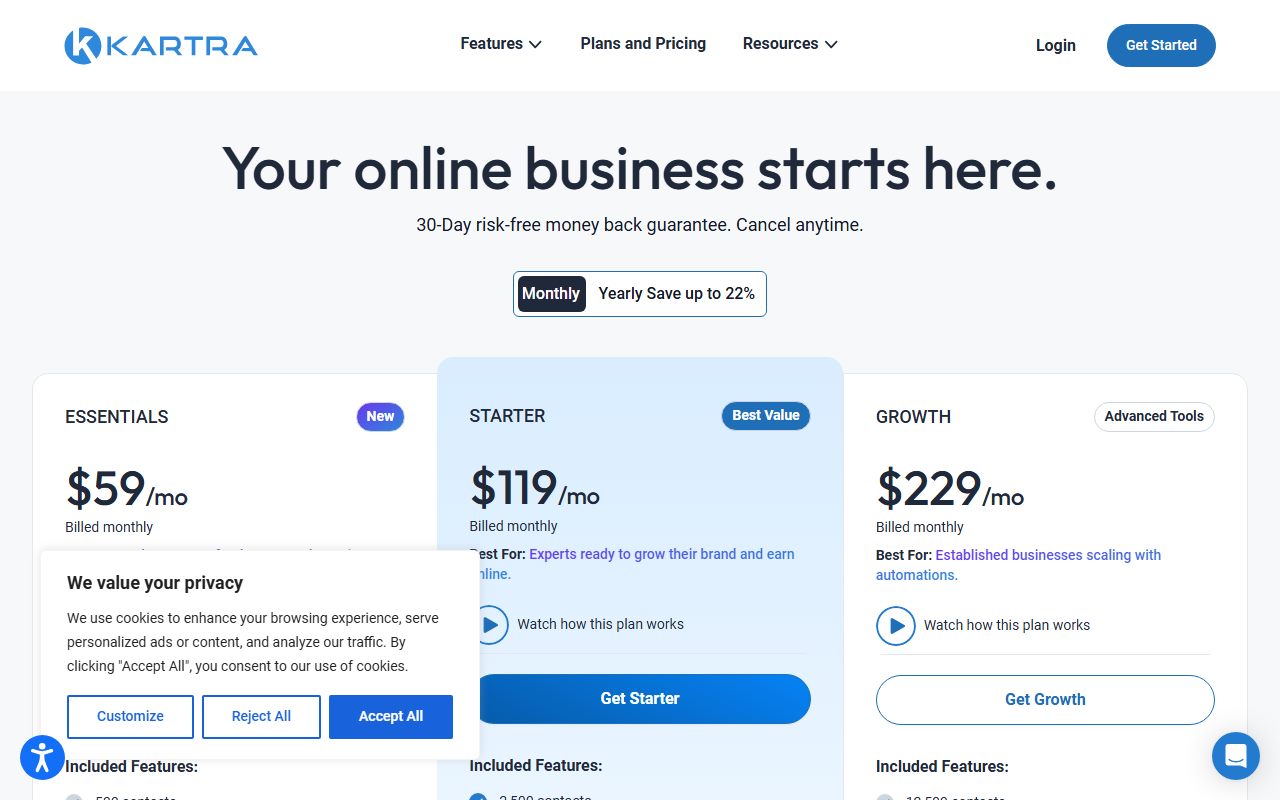
Kartra's comparison table lists "Lead & sales management" with a check on all four plans, so the contact record is not gated. Contacts are: 500 on Essentials, 2,500 on Starter, 12,500 on Growth and 25,000 on Professional.
What is gated is support tooling. The table marks "Helpdesk support" with a dash on the first three columns, and "Affiliate management" the same way, although Kartra's own plan cards disagree with that table on both rows.
Keap is priced like a CRM rather than like a builder. Its page reads "Starting at $299/mo (Billed at $2,988/year)", and its FAQ states "Keap starts you off with 2 user licenses. Additional users can be purchased for only $39/month per user."
That seat charge is the dividing line. Keap bills per person and per contact tier; a funnel builder bills per contact only. Which is cheaper depends on how many people need to log in.
A sales CRM bills by seat, and the gap is wide
Pipedrive's pricing page lists four plans "Per seat per month, billed annually": Lite at "US$ 14", Growth at "US$ 24", Premium at "US$ 49" and Ultimate at "US$ 69", with annual totals of US$168 to US$828 per seat.
HubSpot's Sales Hub page shows a free tier at "$0 /mo" that is "Free for up to 2 users", then "Starter $7 /mo/seat" against "$20 /mo/seat" for monthly commitment, "Professional $90" against "$100", and "Enterprise $150".
The row most buyers miss is the onboarding line. HubSpot states: "Cost shown does not include the required, one-time Professional Onboarding for a fee of $1,500", and $3,500 for Enterprise.
Its feature table also caps structure rather than records: "Pipelines Up to 15 total pipelines per account". So even a seat-priced CRM meters pipelines, just at a higher number than a funnel builder does.
Where the two models cross over
The arithmetic below is ours, using the published rates above, for a five-person team with 8,000 contacts.
- Systeme.io Webinar: $47 a month, 10,000 contacts, 20 CRM pipelines, no per-seat charge listed.
- ClickFunnels Scale: $164 a month billed annually, 75K contacts, 5 team members, CRM pipelines included.
- HighLevel Starter: $97 a month, unlimited contacts and users, plus usage charges for every call and text.
- Keap: $299 a month plus $39 for each user beyond two, so about $416 a month for five people.
- Pipedrive Growth: US$24 per seat billed annually, about $120 a month for five seats, with no funnel pages at all.
- HubSpot Sales Hub Starter: $7 per seat billed annually, about $35 a month for five seats, plus whatever you pay for pages elsewhere.
Read that list twice. The seat-priced CRMs are the cheapest line on it, because they do not host your checkout, your pages or your email. The funnel builders look expensive because the CRM is bundled with everything else.
The honest comparison is therefore not CRM against CRM. It is one bundled bill against the sum of a page builder, an email tool and a CRM, which is the exercise in how to read a funnel builder pricing page.
Four questions before you trust the CRM label
- How many pipelines does your plan allow, and is that row counted or unlimited?
- Are automations included on your tier, or does the pipeline move by hand?
- Is the billing unit contacts or seats, and how many people need to log in?
- What is metered on top: calls, texts, AI credits, or onboarding?
If the answer to the third question is more than five people, a seat-priced CRM beside a cheap builder usually wins. If it is one or two, the bundle wins and the CRM is effectively free.
Either way, check the contact meter's counting rules before you compare, because they differ by vendor. That is the subject of what funnel builder contact limits actually count and ActiveCampaign vs Mailchimp plans.
And treat the unlimited labels on both sides with the same suspicion, as in unlimited funnels is not unlimited. If you are trialling one, our funnel builder free trial checklist lists the rows to confirm first.
Frequently asked questions
Is the CRM in a funnel builder a real CRM?
It is a pipeline board plus a contact record. Systeme.io counts "CRM Pipelines" as 1, 5, 20 and 100 by plan; ClickFunnels gives Launch exactly one. A sales CRM like HubSpot allows up to 15 pipelines per account.
Which is cheaper, a bundled CRM or a standalone one?
Standalone is cheaper per user: Pipedrive Lite is US$14 per seat billed annually and HubSpot Starter $7. But neither hosts pages, checkout or email, so the comparison only works against your whole stack.
Does any funnel builder include unlimited CRM users?
HighLevel's pricing page states "Unlimited contacts, unlimited Users" on all plans from $97 a month. It charges usage-based fees for phone numbers, SMS and emails instead, which its FAQ confirms in writing.
How much does Keap charge per user?
Its FAQ says Keap includes 2 user licences and that "Additional users can be purchased for only $39/month per user", on a platform price starting at $299 a month billed at $2,988 a year.
Are there setup fees on a standalone CRM?
On HubSpot, yes, above Starter. Its pricing page states the displayed cost excludes "the required, one-time Professional Onboarding for a fee of $1,500", rising to $3,500 for Enterprise.
Can a funnel work without the builder's CRM?
Yes, but check what breaks. On ClickFunnels the "Automations" row shows a dash on Launch, so a pipeline on that plan advances manually unless an outside tool receives the checkout events.
Bottom line
The CRM inside a funnel builder is a pipeline, a contact record and a counting rule. It is genuinely useful for a one or two person operation, and it is bundled, so it costs nothing extra at that size.
Past about five logins, seat pricing starts to look like the bargain it is, and the bundle starts to look like a tax on everything you were not going to use. Confirm each figure on the vendor's page before deciding.
Sources
- Systeme.io pricing (Contacts & CRM section of the comparison table) (checked Oct 21, 2026)
- ClickFunnels pricing (feature comparison table) (checked Oct 21, 2026)
- HighLevel pricing (plan cards, core feature list and FAQ) (checked Oct 21, 2026)
- Kartra plans and pricing (plan cards and comparison tables) (checked Oct 21, 2026)
- Keap pricing (plan price, user licences and FAQ) (checked Oct 21, 2026)
- Pipedrive pricing (per-seat plan cards) (checked Oct 21, 2026)
- HubSpot Sales Hub pricing (seat prices, onboarding fees, pipeline cap) (checked Oct 21, 2026)